
The Engineering Mastermind: Arthur Looff and the 1924 Construction
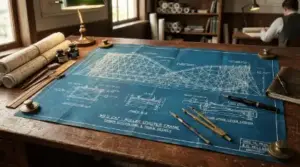 In the early 1920s, Arthur Looff—son of pioneering carousel builder Charles I. D. Looff—envisioned a roller coaster that would deliver an unprecedented combination of speed, height, and visual drama along Monterey Bay. Designed by Looff and structurally engineered by legendary coaster designer Pryor & Church, construction on the Giant Dipper began in January 1924. Remarkably, the entire structural frame was erected in just 47 days at a total cost of $50,000.
The mechanical architecture of the Giant Dipper represents classic “gravity coaster” engineering. Standing 70 feet tall with a 65-foot initial drop and reaching speeds up to 55 miles per hour across 2,640 feet of track, the ride relies on precise structural balance and timber flexibility. The frame was constructed primarily from high-grade Douglas fir (*Pseudotsuga menziesii*), chosen for its exceptional strength-to-weight ratio and natural resilience under dynamic mechanical loads.
Key structural engineering choices that enabled its long lifespan include:
- Laminated Wooden Track Assemblies: The track bed consists of multiple layers of Douglas fir boards stacked horizontally and bound together, distributing localized mechanical stress across the entire frame.
- Cross-Braced Timber Trestles: Diagonal cross-bracing throughout the vertical towers helps absorb lateral force generated by high-speed trains navigating tight, banked turns.
- Gravity-Fed Braking Mechanisms: Manual, mechanical brake levers using heavy steel calipers clamped onto wooden brake fins along the track, providing reliable stopping power without reliance on digital control systems.
Coastal Environment Challenges: Fighting Marine Decay and Salt Spray
Operating a massive wooden structure in a harsh marine environment poses continuous engineering hurdles. The Santa Cruz coastline presents a triad of natural degradation forces: elevated ambient humidity, persistent salt spray deposition, and seasonal seismic threats along the Central Coast fault zones.
Salt spray carries microscopic sodium chloride particles that penetrate unsealed wood fibers, leading to accelerated chemical weathering and moisture retention. Left unmanaged, persistent dampness fosters wood-decay fungi, while seasonal temperature swings cause wood expansion and contraction that loosen steel bolts and tie-plates. Furthermore, marine wind exposure causes structural fatigue across load-bearing joints.
To counteract these environmental stresses, the maintenance crew at the Santa Cruz Beach Boardwalk maintains a rigorous, continuous preservation program:
- Daily Structural Inspections: Certified ride inspectors walk every foot of the 2,640-foot track every morning before operations begin, manually testing bolt torque, inspecting wooden laminates, and evaluating track alignment.
- Rotational Timber Replacement: Rather than replacing the entire structure at once, carpenters perform targeted, section-by-section wood replacements annually using sustainably harvested Douglas fir treated for outdoor marine exposure.
- Marine-Grade Protective Coatings: The coaster’s distinctive red-and-white frame undergoes continual repainting using high-durability, UV-resistant, marine-grade enamel paints that seal wood fibers against moisture infiltration.
- Steel Hardware Upgrades: Original iron fasteners have gradually been upgraded to hot-dipped galvanized steel and marine-grade stainless steel hardware to prevent galvanometric corrosion within the wood joints.
Historical Landmark Status and Cultural Impact on Santa Cruz
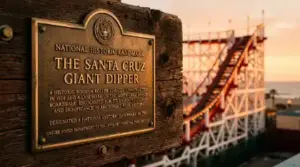
The cultural significance of the Giant Dipper extends far beyond its engineering feats. In 1987, the United States National Park Service officially designated the Giant Dipper as a National Historic Landmark—a distinction held by only a tiny fraction of operating amusement rides nationwide. This designation recognizes the coaster as an irreplaceable artifact of American popular culture and seaside architectural history.
Throughout its century-long operation, the Giant Dipper has served as an economic and cultural anchor for Santa Cruz County. It has survived major natural disasters that reshaped the Central Coast, including the devastating 1989 Loma Prieta earthquake. While the earthquake caused widespread damage throughout downtown Santa Cruz, the Giant Dipper’s flexible timber construction allowed the frame to sway and absorb seismic energy without suffering catastrophic structural failure. After rigorous safety inspections, the coaster reopened shortly after the quake, becoming a symbol of community resilience.
Today, the Giant Dipper stands as the centerpiece of the Santa Cruz Beach Boardwalk, attracting over a million riders each year and bridging generations of local families, historians, and engineering enthusiasts.
The Next 100 Years: Modern Preservation Meets Historic Integrity
As the Giant Dipper enters its second century of operation, structural engineers and historical preservationists face a delicate balancing act: integrating modern safety technology and materials science while strictly preserving the coaster’s historic architectural integrity.
Recent restoration efforts have introduced advanced non-destructive testing methods, such as ultrasonic wood density testing and digital laser alignment tracking, allowing engineers to identify internal wood degradation before visible surface damage appears. At the same time, custom-machined train chassis designed to match historic Looff specifications ensure that the sensation and acoustics of the ride remain identical to what visitors experienced in 1924.
By treating the Giant Dipper as both a living mechanical monument and a historical treasure, Santa Cruz County preserves a vital link to California’s coastal past. The continued survival of this century-old wooden giant proves that with dedicated stewardship, historical engineering can continue to thrive alongside modern innovation.