
Long before thousands of visitors flocked to the boardwalk or navigated the curves of Highway 17, Santa Cruz County was a geographically isolated coastal frontier. Hemmed in by the dense, towering old-growth redwoods of the Santa Cruz Mountains to the north and east, and the vast Pacific Ocean to the west, early settlers faced a monumental challenge: how to move massive resources like timber, limestone, and agricultural yield to global markets.
The solution lay in nineteenth-century human ingenuity. Through a series of daring engineering feats—carving rail lines through mountain granite, extending colossal timber wharves deep into ocean swells, and fashioning distribution networks out of hollowed redwood logs—Santa Cruz County laid the groundwork for modern coastal California. This is the story of the foundational infrastructure systems that built the county from the ground up.
The Railroad Revolution: Piercing the Santa Cruz Mountains
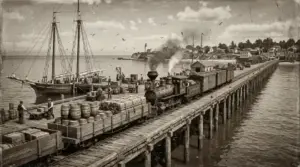
In the mid-1800s, transporting goods out of local hubs like Felton, Soquel, and Watsonville meant relying on slow, ox-drawn wagons navigating treacherous, muddy dirt tracks. The local logging and limestone industries were booming, but land transport threatened to bottleneck the entire regional economy.
The transformation began in earnest in 1875 with the completion of the Santa Cruz & Felton Railroad. This ambitious narrow-gauge line connected the timber-rich San Lorenzo Valley directly down to the coast. Engineers built steep grades and tunnels alongside river canyons to bring raw lumber and barrels of lime straight to the shoreline.
Soon after, local enterprise took another leap forward. Entrepreneur Frederick A. Hihn spearheaded the creation of the Santa Cruz Railroad, linking Santa Cruz to Watsonville and connecting the county to the transcontinental rail lines. By 1880, James Graham Fair’s South Pacific Coast Railroad pulled off the ultimate engineering feat: drilling a series of long, dangerous tunnels straight through the Santa Cruz Mountains to link Monterey Bay directly with San Francisco Bay. Trains could now haul millions of board-feet of redwood and farm produce directly across Northern California, irrevocably tying Santa Cruz to the state’s broader economic engine.
Gateway to the Pacific: The Evolution of Coastal Wharves
A railroad is only as effective as its terminus. Because Santa Cruz lacked a deep-water natural harbor, ships were forced to anchor offshore while cargo was rowed through heavy surf—a practice that was inefficient, dangerous, and costly. To conquer the waves, early industrial pioneers turned to building wharves.
Between 1849 and 1914, no fewer than six different piers and wharves were built along the Santa Cruz coastline:
- The Cowell Wharf (1849): Built initially by Elihu Anthony and later operated by lime magnates Davis & Cowell, this structure at the foot of Bay Street served as the early pipeline for exporting local lime used to build San Francisco.
- The Gharky / Powder Mill Wharf (1857): Built by David Gharky, this pier was eventually acquired by the California Powder Works company to ship black powder for mining and military use.
- The Railroad Wharf (1875): Constructed specifically for the narrow-gauge trains, this massive wooden pier allowed train engines and boxcars to drive straight out over the ocean water, dumping cargo directly into steamships and schooners.
- The Santa Cruz Municipal Wharf (1914): As steamships grew larger and ocean swells repeatedly damaged older wooden piers, the city engineered a grand 2,745-foot structure. Equipped with standard-gauge railway tracks and angled to withstand ocean currents, it remains the longest timber wharf on the West Coast today.
For more detailed historical context on the region’s maritime trade developments, explore the comprehensive archival research at the Santa Cruz Trains Historical Archive.
Taming the Elements: Pioneer Water & Power Networks
While trains and wharves brought wealth into Santa Cruz County, a reliable supply of fresh water was necessary to sustain its growing populations and industrial operations. The early water systems of Santa Cruz were masterpieces of rustic engineering.
The region’s first organized water infrastructure dates back to the Spanish Mission era with the construction of the mission zanja in 1792—a stone and tile-lined canal that redirected water from local springs to the mission complex along present-day High Street.
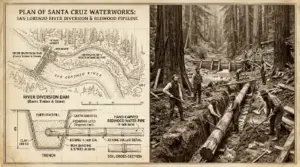
By the mid-1850s, local inventor Elihu Anthony and businessman Frederick A. Hihn elevated civic infrastructure by fashioning the town’s first public water distribution pipes out of local redwood logs. Hearty redwoods were bored through the center, joined together end-to-end, and laid underground to transport clean spring water from the hills into downtown businesses and residences.
As the city expanded, private enterprises like the Santa Cruz Water Company constructed diversion dams along Branciforte Creek and pumped water from the San Lorenzo River up to hilltop gravity reservoirs on Logan Hill. These pioneer networks provided the pressure needed for industrial manufacturing, domestic supply, and vital fire suppression during an era when wood-frame towns were perpetually at risk of destruction.
Disaster, Resilience, and Infrastructure Modernization
The history of Santa Cruz infrastructure is not just a tale of construction—it is a story of survival and adaptation. The rugged coastal terrain that made Santa Cruz beautiful also subjected its engineering marvels to extreme natural disasters.
The 1906 San Francisco earthquake damaged mountain railway tunnels, triggering landslides that wiped out sections of track. Later, the catastrophic Christmas Flood of 1955 sent the San Lorenzo River roaring through downtown Santa Cruz, destroying bridges and inundating commercial districts. In response, the U.S. Army Corps of Engineers constructed the San Lorenzo River Flood Control Project, re-engineering the river channel with levees and floodwalls that protect the city center to this day.
Simultaneously, the advent of the automobile age in the mid-20th century transformed transport. The mountain railways were gradually abandoned or repurposed for tourism (such as the beloved Roaring Camp & Big Trees Narrow Gauge Railroad in Felton), making way for modern thoroughfares like Highway 17 and Highway 1.
The Legacy of Early Coastal Engineering
Today, as we drive along the coast or stroll along the Santa Cruz Municipal Wharf, it is easy to take these connections for granted. Yet, every corner of Santa Cruz County bears the mark of its pioneer builders. The old railroad rights-of-way now serve as scenic corridors and active recreation trails; the historical wharf remains a bustling center of commerce and tourism; and municipal water systems still tap the coastal springs engineered over a century ago.
By conquering mountain passes, ocean tides, and wild rivers, early engineers transformed Santa Cruz from an isolated pocket of Wilderness into a thriving, resilient California community.